Showing posts with label Heritage. Show all posts

Tuesday, May 20, 2025

Return to Ilocandia | Revisiting the Heritage Province of Ilocos Sur

Walking along the cobblestone roads and looking at the colonial stone houses in an old heritage city give us the feeling of going back to the past. It is also nostalgic seeing classic structures standing still until the contemporary time, which was preserved by the people, serving historical and cultural traces of the past in a certain town or city reflecting its local color.

In the commemoration of National Heritage Month 2025, let us explore and visit some of the cultural sites that reflect the traditions and history of the Ilocos Region.

The empty Calle Crisologo with classic and contemporary structures in a cobblestone street before sunrise.
The first stop in our tour for the first day is the historic city of Vigan. Known for its colonial houses preserved during the Spanish era with its classic architecture combined with European and Oriental influences, Belgian block roads, and the use of calesa as its mode of transportation, making it a UNESCO World Heritage Site in 1999.
Cozy cafes and fast food chains inspired by Spanish-era architecture became main attractions in the city.
Calesa, a horse carriage during the Spanish era, is the most common mode of transportation.
Furthermore, the city has founded in 1572 by conquistador Juan de Salcedo and named it as "Villa Fernandina de Vigan" in honor of Prince Ferdinand, son of King Philip II of Spain. Vigan is also the birthplace of Leona Florentino, the mother of Philippine women's literature and Elpidio Quirino, the sixth president of the Philippines. 
Some buildings in Calle Crisologo need to undergo renovation due to damages done by earthquake.
Early morning sunrise at Calle Crisologo.
The memorial marker of Jose Burgos (left) located in Plaza Salcedo and the monument of Leona Florentino in Calle Crisologo (right).
There are many renovations are still ongoing after an earthquake struck in the city in 2022, resulting into damages in old structures such as various old houses in Calle Crisologo, Vigan Cathedral, and even the church and its bell tower in its neighboring town of Bantay.
The panoramic view of Bantay Bell Tower as seen from Bantay Church grounds.
Bantay Bell Tower.
Bantay is located few kilometers away from Vigan which was one of the early towns in Ilocos Sur founded in 1593. It is also the home of Bantay Church (Saint Augustine Church) that houses the image of Apo Caridad (Our Lady of Charity). Furthermore, the church and the belltower are some of the oldest structures in the province. However, the church and the belltower were struck by a magnitude 7.0 earthquake on 2022.
Bantay Bell Tower and the Foodmarks marker in Vigan.
There are still many heritage and historical sites in the province as we continue to explore it in the future and even revisiting the next destination - Ilocos Norte. 

Date of Travel: April 25, 2025

Monday, December 24, 2018

Manila Heritage Nostalgia | The Second Visit at the Museum of Natural History

After months of waiting, the galleries at the National Museum of Natural History are done. They can be visited by the public and you may explore more about the natural richness of our country in terms of resources from land to sea.
The facade of Museum of Natural History which was formerly known as the Department of Tourism office.
Since its opening, there are many visitors who come to this museum
to see the natural and scientific heritage of our country.
The remains of Lolong are one of the most visited exhibits in the museum.
The replica of our planet Earth.
Remains of the dugong.
A bat-winged slug with its scientific name Siphopteron nakakatuwa. "Nakakatuwa" is a Tagalog word meaning amusing.
When I entered the museum, I visited the gallery on the ground floor which featured the varieties of wood in the country. Also, I visited again the exhibit where the remains of Lolong can be found. Definitely, the visitors come to this exhibition and they have this photo opportunity. Adjacent to the exhibit is the gallery called "Our Natural Inheritance." You can watch an audio-visual presentation of the natural heritage sites in our country which are preserved to save the nature. You can also check the replica of our Earth and the newly-discovered plant and animal species discovered in our country. I also got the chance to visit again the Marine Realm Gallery and this time, I've got the chance to enter inside the Abyss or the deepest part of the ocean. It is creepy at first but you will be amazed with the kinds of creatures that you will see in the mysterious part of the ocean such as angler fish.
A rainforest diorama which reminds me of a canopy trail featuring different trees and animals.
The tamaraw.
Civets and rats.
Philippine boar
Birds and rats living in mossy forests (top) and a canopy train in an evergreen rain forest (bottom).


Different variety of insects from bugs and butterflies in the forest.
A replica of a pine forest (top) and the habitat in a rainforest (bottom).
Replica of dwarf forests.
In this museum tour, I've got the chance to visit the newly opened galleries in the fourth and fifth floor. First, the Lowland Evergreen Rainforests gallery. You can see the different plants and trees found in the Philippine rain forests such as birds, fruit bats, snakes, rats, insects, civets, boars and other reptiles.You may also visit the Mossy, Montane and Pine Forests where you can see the animals living in the pine forests.  In fact, you may also see a replica of pygmy forests which can be found in the provinces of Dinagat Island and Davao Oriental.
A replica of limestone forests.
A diorama of caves with stalactites and stalagmites.
Examples of stalactites and stalagmites.
Don't also forget to visit the exhibit for Limestone and Karst Forests. You can see some examples of stalactites and stalagmites and a replica of a cave and limestone forests. Actually, it's been a long day seeing the sights and sounds of this museum, especially exploring the biodiversity of our country in this museum.
Snails and crabs which can be found in the freshwater wetlands.
Different lakes in the Philippines such as the Taal Lake in Batangas, Twin Lakes, Lake Sebu in South Cotabato,
Paoay Lake in Ilocos Norte and Seven Lakes of San Pablo City, Laguna.

Different aquatic creatures found in the freshwaters. 
You may also visit the gallery of Freshwater Wetlands. You can see there the diorama of different lakes in the Philippines as well with replica of animals found in the freshwater wetlands.

Watch out also for the third and final part of this post which is also included in my second visit in the National Museum.

Note: Thanks to PhotoGrid for some photo collages featured in this blog :)

Date of Travel: November 17, 2018

Tuesday, December 18, 2018

First Ilocandia Escapade | An Afternoon Visit in a Historic City of Vigan

The Philippines is noted for its several cultural heritage sites traced back to its history. Most of these places are preserved since the pre-colonial times such as the Banaue Rice Terraces, while others are maintained since the Spanish era. Therefore, these historical sites are visited by tourists in order to explore the history and culture of our country.
The UNESCO World Heritage City of Vigan in an afternoon visit.
In this blog, there are posts which are featured heritage cities which are preserved dating back from the Spanish colonial period. Some of these were visited and featured in blog such as Intramuros in Manila, Pila in Laguna and Taal in Batangas. These three heritage sites were featured in my blog which expressing my thoughts of traveling back in time because of the architecture in ancestral houses and structures which are made during Spanish colonial times. Therefore, I visited another heritage city which made my bucket list complete in this tour - the Heritage City of Vigan.
Vigan City is one of the New 7 Wonders Cities.
Before we go home to Cavite, we never missed the opportunity to visit this old Spanish city of Vigan. Located on the western coast of Ilocos Sur, Vigan is one of the few towns left in the Philippines whose old houses and structures are remained intact. The city is known for its sett pavements and a unique architecture of the Spanish colonial era in the Philippines. There are abundance of bahay na bato (literally house of stone) houses and an Earthquake Baroque church. In fact, the entire city was inscribed as a UNESCO World Heritage City after being declared as a UNESCO World Heritage Site in 1999. In 2015, Vigan City was officially recognized as one of the New7Wonders Cities.
The Saint Paul Metropolitan Cathedral located in Plaza Salcedo.
The bell tower of Saint Paul Metropolitan Cathedral.
Before we begin the roaming tour in the city, we visited the Saint Paul Metropolitan Cathedral. It serves as the seat of the Roman Catholic archdiocese of Nueva Segovia in Ilocos Sur. It was built in 1574 as a church made up of wood and the present day church was built from 1790 to 1800 under the supervision of Augustinians.
Plaza Salcedo
Plaza Burgos
Ilocos Sur Provincial Capitol
The church is located within the Plaza Salcedo which featured a dancing fountain and light show in the evening and an adjacent plaza called Plaza Burgos which is noted for its food stalls. You can also find the Ilocos Sur Provincial Capitol within the vicinity of the town center.
Faded walls and capis windows are evidences of the 
There are many tourists walked in this century-old street.
It is amusing to see Mamang Sorbetero (ice cream vendor) with his ice cream cart.
The Kalesa or horse-drawn carriage is very common in the Philippines until today.
The sights and sounds of Calle Crisologo.
Then, we entered at the Calle Crisologo, the most popular ancestral street in Vigan. You have this time traveling back in time because of the stone houses which were preserved since the Spanish era. The sett pavements (also known as Belgian blocks or sampietrino) which are common during the colonial era and the calesa (a horse drawn carriage) is the most common mode of transportation in the street. Seeing those bahay na bato (stone houses) made and preserved since the Spanish era are quite amusing because it remained intact in the actual place. Nowadays, the ancestral houses are business establishments, historical museums and transient houses and hotels, however, the structure and architecture remained intact.
The Ilocos Sur Provincial Tourism Office.
The ancestral house of Leona Florentino, the first female Filipino poet and her son, Isabelo Delos Reyes
the first Filipino who organized a labor union.
Aside from roaming along the old streets of Calle Crisologo, you may also visit the ancestral house of Leona Florentino, the first Filipina poetess and noted for her poems such as "Blasted Hopes." Her son, Isabelo Delos Reyes played an important role in history which he organized the first labor union in the Philippines and he did a major role in the Aglipayan Church. Today, there are two establishments shared in their ancestral house - a restaurant named Cafe Leona and the Ilocos Sur Provincial Office. In addition, Elpidio Quirino was also born in Vigan, Ilocos Sur.
An afternoon scene in Calle Crisologo.
We've done a lot of things in this place from souvenir shopping, photo sessions, and strolling in the streets of Calle Crisologo. We enjoyed the last part of our Ilocos Tour and definitely, memories will be treasured and if we were given a chance to come back, definitely, we will grab the opportunity to explore more about the Ilocandia. 

Date: August 27, 2018

Monday, December 17, 2018

First Ilocandia Escapade | A Day Tour on Ancestral Heritage Treasures of Ilocos Norte

Every Philippine city has its hidden beauty, a cultural heritage and a colorful history. From the previous travel experiences I've had, I never forget to check the heritage sites in every place that I visit. For the third and final day of our tour, the weather is fine and it is the perfect time to go home. Before that, we visited some of the cultural heritage sites from Ilocos Norte back to Ilocos Sur. Let us have first the tour in the historical treasures of Ilocos Norte.

DIY Laoag City Tour
Laoag City
The facade of Ilocos Norte Capitol taken from the bus.
The Ilocos Norte Provincial Capitol
The fountain at the Aurora Park
While waiting for my colleagues to come back while having their morning exercise, I decided to go alone on a city tour to explore some of the heritage sites that you can find there. First, I visited the Ilocos Norte Provincial Capitol and roamed around the Aurora Park where you can find the monument of the Abolition of Tobacco Monopoly. 
The Sinking Bell Tower in Laoag City.
The Saint William's Cathedral or the Laoag Cathedral is a Baroque church in Ilocos Norte.
Therefore, the most important highlight in this do-it-yourself walking tour is the visit to the Laoag Cathedral. Also known as Saint William's Cathedral or Catedral de San Guillermo, this Spanish-era Baroque church was built in 1612 by the Augustinian friars. Don't forget also to visit the Sinking Bell Tower. This belfry is literally sinks into the ground at a rate of inch per year. It survived several minor earthquakes. The tower is made up of old brick and stone-faced with lime stucco plaster, the tower rises in four tiers.

Santa Monica Church
Sarrat
The Santa Monica Church, also known as Sarrat Church, another Baroque church in Ilocos Norte.
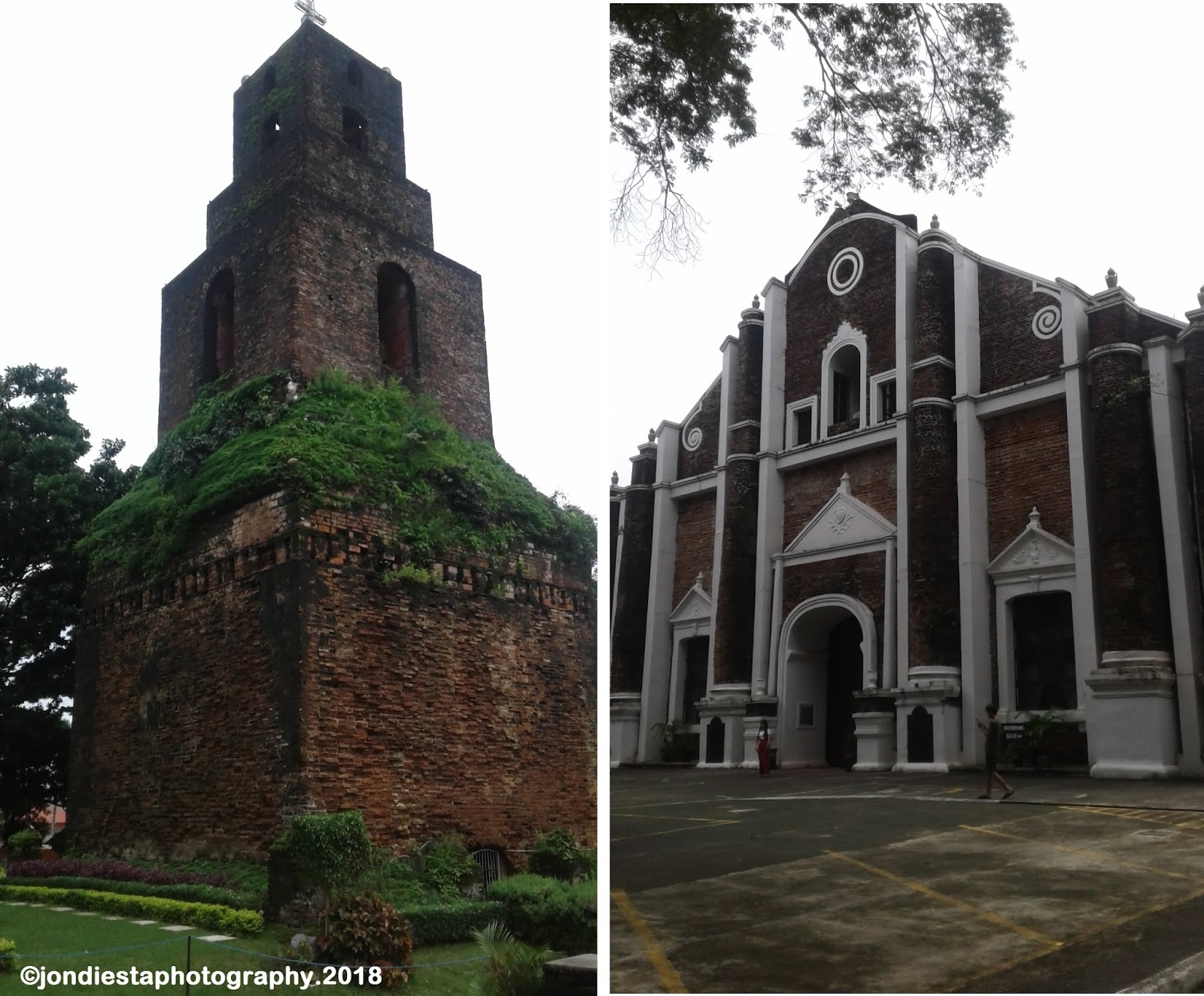
The belfry made up of bricks and covered with plants (Left) and the facade of the century old church (Right).
After my me-time in the city, I decided to pack up my things and join the team going to our next destination - Sarrat. The town is known as the birthplace of Ferdinand Marcos and for the Sarrat Church, the largest church in the province and with the longest nave in the country. In fact, we visited this cultural treasure known as the Santa Monica Church.
The old convent known as the Casa Palacio del Real.
The structure is made up of red bricks, but you need to be extra careful with these mosses.
This is the biggest church in Ilocos Norte which is made up of bricks built in Earthquake Baroque and Neoclassical architecture. It was first built in 1724 and the church witnessed several historical events especially the venue of the grand wedding of Irene Marcos, daughter of President Ferdinand Marcos and Gregorio Araneta in 1983.

Malacanang of the North 
Paoay
The entrance to Malacanang of the North.
It is a presidential museum of the Marcos family and the official residence
 of President Marcos during his administration.
The view of Paoay Lake.
Opening new doors for a bright future... taken from the doors of Malacanang Ti Amianan.
A few minutes away from the town of Sarrat, we returned at Paoay to visit the Malacanang of the North (Ilocano: Malacanang ti Amianan). The two-storey mansion is known as the presidential museum of Ferdinand E. Marcos and the official residence of his family during his administration. Inside the mansion, you can see different historical events during the Marcos administration and some memorabilla of the Marcos family.

Paoay Church
Paoay
Local and foreign tourists include Paoay Church in their bucket list of Ilocandian Tour.
The facade of the church.
The belfry played an important role in the history of this place.
After lunch, we had a chance to visit the Saint Augustine Church, simply known as the Paoay Church. Your Ilocandia tour will not be complete if you don't visit this iconic church in the North. The parish was founded by the Augustinian missionaries in 1593, the building of the present church was started in 1694 and completed in 1710. The church showed an example of Earthquake Baroque architecture made up of large coral stones on the lower part and bricks on the upper levels and its walls suggest Javanese architectural styles. Adjacent to the facade is the bell tower which served as a protection against earthquakes and an observational post by the Filipino revolutionaries against Spain in 1896 and by the Filipino guerillas against the Japanese forces during World War II.
The Paoay Church is one of the National Cultural Treasures in the Philippines and a UNESCO World Heritage Site.
Therefore, Paoay Church was declared  as a National Cultural Treasure by the Philippine government in 1973. In addition, the church was designated as a UNESCO World Heritage Site on December 11, 1993, together with other Baroque churches - San Agustin Church in Manila, Miag-ao Church in Iloilo and Santa Maria Church in Ilocos Sur.

For this day, the weather is very fine and we enjoyed the heritage tour for the final day of our Ilocandia Escapade. It feels like visiting those churches from Laoag, Sarrat and Paoay makes you feel like you already had your Visita Iglesia in Ilocos plus interesting historical sites which creates an insight of traveling back in time. The second part of this post will be our afternoon visit in the Heritage City of Vigan, Ilocos Sur.

Date: August 27, 2018
© No copyright infringement intended.