Showing posts with label Historical Buildings. Show all posts

Tuesday, April 29, 2025

A Close Visit to La Union | Surfing the Horizons

From a province usually passed by until I get the chance to have a closer look of this "Surfing Capital of Ilocos Region". 
Tourists flocked at the shore of Luna, La Union in the Baluarte Watchtower overlooking the sea.
La Union is a province located at Ilocos Region, noted for its surfing spots, old churches, grape vines, and red clay pottery. It is the gateway going to Ilocandia, being the first province passed by travelers for those who are going to Ilocos Sur, Ilocos Norte, and Abra. Furthermore, I have a chance to visit last December 2024, although I passed it in this province in 2018 which is the usual route going to Ilocos Provinces.
Baluarte Watchtower in Luna is one of the old Spanish lighthouses in the province
while other old lighthouses are just ruins found in towns in La Union including Balaoan,
Bacnotan,San Fernando, and San Juan.

The old brick watchtower is one of the tourist attractions in La Union.

There are few sites that I visited in this province. First, the Baluarte Watchtower located in the town of Luna, which was built during the Spanish era. It was intended to guard the shores against pirates and Muslim invaders during the Spanish colonization and it served as a communication tower post for Filipino and American armed forces during the World War II. 
The circular interior of Baluarte Watchtower. 
Due to the quarrying within the tower' site, the coastline receded, and the sea waves damaged the foundation of the tower. Furthermore, efforts are made to preserve the ruins of Baluarte Watchtower, and it served as a tourist spot for those who visit the province. 
A warning sign indicating dangerous waves for safe swimming and surfing.
The strong blue waves of La Union which makes the province one of the prominent surfing capitals.
Where the ocean meets the shore. An ideal time to swim to enjoy the stay in the province. 
Moreover, the beach resorts and surfing spots of La Union truly make this visit a memorable one. Simply enjoying the strong, foamy waves of the blue sea. Furthermore, the province is also rich in aquatic resources which can be a source of food and livelihood for the residents. 
Sunset in San Juan, La Union as it signals another evening for parties and night life. 
Other activities in La Union that you can enjoy including church visits, nature trips in forests and waterfalls, grapes picking, buying of dried fish and local delicacies, and enjoying the nightlife. 

Therefore, La Union is a place which you can come back for more - exploring the history, enjoying the surfing and beach parties, and appreciating the nature. 

Date of Travel: December 20-21, 2024

Tuesday, August 20, 2013

Remembering the Roots of Our National Hero: Calamba City Tour

Calamba City is one of the most progressive cities in the Southern Tagalog region and it is the center of economic, political, cultural, and educational activities in the province of Laguna. It is located 54 kilometers south of Metro Manila and it is surrounded by the towns of Cabuyao and Los Banos, Laguna; Tagaytay City, Cavite and Tanauan and Santo Tomas, Batangas. 
The Kalan Banga of Calamba City.
The names of barangay in Calamba were written in the huge jar stone.
The woman who answered the question to the Spanish soldiers.
How Calamba got its name? There were two Spanish soldiers who saw a woman in the river bringing a jar stone full of water. Then one of the soldiers asked a question using their language to the woman about the place that they have visited. Then the woman answered the question using her native dialect and she answered "kalan banga" (kalan means "stove" and banga means "jar stone"). As time goes by, the place was called Calamba from the word "kalan banga."
Rizal Shrine with plants and trees surrounded the house.
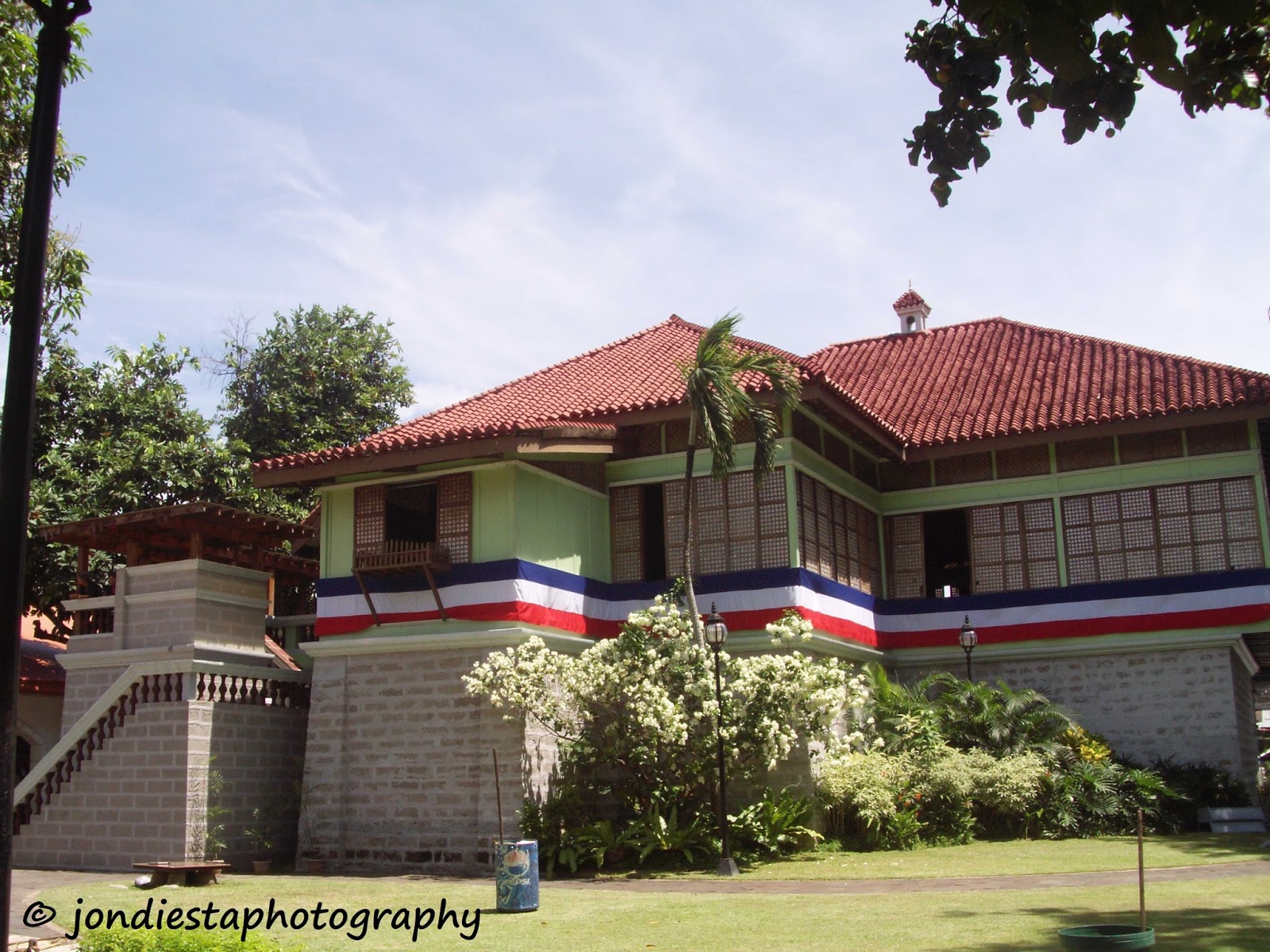
The facade of Rizal Shrine.
Dining Room at Rizal's house.
Nipa hut 
Calamba is the town where our national hero, Dr. Jose P. Rizal was born. Today, his ancestral house is the most visited tourist spot here in the city. It is made up of stone which reflected their life as ilustrados or Filipinos who belong to the elite society. It was also surrounded by trees and plants and they also have a nipa hut. The reconstruction of the house was planned by Elpidio Quirino for the commemoration of Dr. Jose P. Rizal as our national hero.

Plaza Rizal
The largest Rizal statue in the country.
In front of Calamba City Hall, there's the Plaza Rizal where the largest Rizal monument was located in that place. As you go upstairs to the statue, you can see a closer look to Mt. Makiling and the city hall.

In addition, Calamba is also famous for its numerous resorts and hot springs which can be found in the foothills of Mount Makiling. Therefore, visiting Calamba City is such a great experience where I have a chance to go in their ancestral house in order to get a glimpse of history of our country. Today, it is one of the urbanized cities in our country where there are residential areas, industrial sites, malls and business establishments in the city. However, it remains the home of our national hero.

Date of Travel: June 10, 2012

Saturday, April 20, 2013

Biyaheng Bonifacio (Part 3): Quezon City Trail

In the continuation of Biyaheng Bonifacio trail, I decided to go back to Metro Manila where I will visit two more historical sites in Quezon City. 
The welcome arc of Krus Na Ligas.
The Krus Na Ligas marker in the church.
1. Krus Na Ligas
Brgy. Krus na Ligas, Quezon City

The first site that I visited is the Krus na Ligas. It is now a barangay in Quezon City which is located near U.P. Diliman. In this barrio, the group of Bonifacio rested in the area. Katipunero Genaro delos Reyes was sent to Mandaluyong to inform the chapter about the encounter with the enemy.

The Cry of Pugad Lawin Shrine
2. The Cry of Pugad Lawin
Seminary Road, Brgy. Bahay Toro, Quezon City

Fifteen to thirty minutes away from Barangay Krus Na Ligas, I visited the Bahay Toro, a site where the Cry of Pugad Lawin was located. Over 500 Katipuneros gathered at the warehouse of Cabesang Melchora Aquino (Tandang Sora) on August 23, 1896 and tore their "cedulas." They carried assorted weapons: bolos, spears, daggers, a dozen small revolvers and a rifle used by Lieutenant Manuel for hunting birds. This event started the Philippine Revolution which was held in August 26, 1896 in Balintawak.

Thursday, April 18, 2013

Biyaheng Bonifacio (Part 2): Cavite Trail

The province of Cavite played a significant role in our history because it is the place where the Philippine independence was proclaimed. In addition, it is one of the provinces which represent the eight golden rays of the sun in the present Filipino flag because Governor General Blanco proclaimed a state of war in these provinces. Cavite is one of the places which played an important role in the life of Andres Bonifacio. There are historical sites which represent the important events in the life of Bonifacio when he was in Cavite. Let us continue the Biyaheng Bonifacio trail in Cavite.
Imus Cathedral
Andres Bonifacio Monument in Imus Plaza
1. Imus Plaza
Tirona St., Poblacion, Imus, Cavite

Imus Plaza is located in front of Imus Cathedral which can be found in the poblacion or town proper. In this place marks an event where the councils of Magdiwang and Magdalo met at the friar estate house on December 29, 1896. In addition, the councils discuss the framing of the constitution, the establishment of a revolutionary government under new elected officials and the possibilities of merging the two councils.
Tribunal of Noveleta Marker
Tribunal House
2. Tribunal
Gen. Antonio St., Poblacion, Noveleta, Cavite

Fifteen to thirty minutes away from Imus, you can visit the small coastal town of Noveleta which is famous for its beach resorts. Located near at the town hall and the public market, you can visit the Tribunal where Andres Bonifacio, Emilio Jacinto, Pio Valenzuela and Pantaleon Torres established the Magdiwang, a council of the Katipunan. On April 3, 1897, Bonifacio attempted to recapture Noveleta but he was unable to dislodge the Spaniards. In addition, General Pascual Alvarez of Magdiwang council defeated Kapitan Antonio Rebolledo, a Guardia Civil under Mariano Alvarez, the town chief of Noveleta. This incident will be one of the reasons of a siege in Cavite during the Philippine revolution.
Tejeros Convention Site
3. Tejeros Convention
Gen. Trias Drive, Brgy. Tejeros, Rosario, Cavite

One of the most important events in the Philippine revolution is the Tejeros Assembly. It was convened on March 22, 1897 which established a central revolutionary government with Emilio Aguinaldo as President and Andres Bonifacio as Director of Interior. Certain events arising in the convention cost Bonifacio to bolt its action. The site is located near the boundary arc of General Trias and Rosario; besides, a barangay in Rosario was named after the name of the historical convention.
Pinagbarilan Shrine in Indang, Cavite
Bonifacio Shrine in Indang, Cavite
Bonifacio Marker in Indang Municipal Hall
4. Pinagbarilan
Brgy. Limbon, Indang, Cavite

On April 22, 1897, the Supremo's troops assigned to guard the fort and they were surprised by the sudden assault of Aguinaldo's men. Ciriaco Bonifacio was killed and his troops captured. Andres Bonifacio was shot with a revolver by Agapito Bonzon and was stabbed on the right side of the neck by Ignacio Pawa. Today, the site is located at Brgy. Limbon in the town of Indang. In addition, you can also find the historical marker beside the municipal hall where Bonifacio was imprisoned before he transferred to Naic.
Naic Elementary School is the present site of Casa Hacienda de Naic.
The dungeon where Procopio and Andres Bonifacio stayed in Casa Hacienda de Naic.
5. Casa Hacienda de Naic
Brgy. C. Nazareno, Poblacion, Naic, Cavite

The present site of Naic Elementary School and located beside the Naic Church , Casa Hacienda de Naic is the place where Bonifacio stayed after the Tejeros Convention. They held the "Naic Military Agreement" or "Acta de Naic." On April 29, 1897, Andres Bonifacio and Procopio Bonifacio were imprisoned here after their capture in Indang.
Bonifacio Trial House
Life-sized statues to depict the trial of Bonifacio brothers.
6. Bonifacio Trial House
Col. Riel St., Poblacion, Maragondon, Cavite

The house was built on 1889 owned by Teodorico Reyes. On April 30, 1897, the Bonifacio brothers were transferred to Maragondon from Naic. On May 4, 1897, Andres Bonifacio and his brother Procopio were tried by a court-martial headed by Brigadier General Mariano Noriel. The following day, the Council of War gave its decision declaring the Bonifacio brothers guilty and recommended the death penalty. However, Aguinaldo issued an order where the brothers put to an isolated place. In the end, he cancelled his order and implement the death sentence after being told by his men.
Bonifacio Execution Site Tableau

Bonifacio Execution Site marker
7. Execution Site
Brgy. Pinagsanhan, Maragondon, Cavite

On May 10, 1897, Andres and his brother Procopio were brought to Mt. Nagpatong which is near in Mt. Buntis. They were executed by Col. Lazaro Macapagal and his troops upon orders of General Noriel took command of a firing squad.

Therefore, the Cavite trail of Biyaheng Bonifacio helped me to appreciate more about the history of the Philippines especially during the Revolution. Bonifacio showed his valor and courage in defending the country as well with the fact that there are some questions and issues in that historical event which needs an answer. These questions can be answered by exploring the past through reading and studying historical chronicles and travelling the sites to discover our heritage. You can read the Manila trail of Biyaheng Bonifacio.

Date of Travel: April 15, 2013

Source: Biyaheng Bonifacio Brochure by Department of Tourism and National Historical Commission of the Philippines

Thursday, April 11, 2013

A Visit to the Ruins of the Old Circular Fort: Baluarte De San Diego

During my tour in Intramuros, I noticed a wooden arc which looks like a cozy garden. I asked the permission to the guards to go inside that place where I paid P50.00 for the entrance fee. Then they gave me the brochure about Intramuros, map of Intramuros and the ticket about the place. As I go around the sophisticated garden, it was an overwhelming moment to see a unique fortification which is one of the oldest structures in the walled city.
Baluarte De San Diego is one of the most interesting places that I've heard in Intramuros. It is because that the circular structure which looks like a maze from above as well with the old stones used in constructing the stone fortification. It is one of the oldest stone fortifications in Intramuros and began as a circular fort called Nuestra Senora de Guia.
Baluarte de San Diego (Source: Google Photos)
It was built and designed by Jesuit priest Antonio Sedeno from 1586 to 1587 which was made of wood.  It was renovated in 1563 to join the walls of the city. Resembling an ace of spades,a cannon foundry and powder factory functioned near the Baluarte during the 18th century. The Baluarte was breached by British force with cannon fire in 1762. It was restored and strengthened after the British occupation where the fort was made of lime (apog) and stone. It was damaged during the earthquakes of 1863 and 1880 and condemned by the Spaniards. It was totally destroyed during the Battle of Manila in 1945. The restoration of Baluarte De San Diego began in 1979 and completed in 1992. 
An old cannon in Baluarte De San Diego Gardens

Stairs to the circular stone fortification.


Baluarte De San Diego
Today, Baluarte De San Diego is one of interesting spots in Intramuros because of its ancient and sturdy walls as well with the circular structure. In addition, the place functions as a garden for events such as weddings and seminars. The place is significant for the Walled City because of the fact that it is one of the oldest stone fortification which reflects the history of our country and the legacy leave by the Spaniards in the Philippines.
The skyline view of  buildings in Manila from Baluarte De San Diego.
How to Get There:
You can go there via pedicab or calesa which takes you to Baluarte de San Diego Gardens. It is located in front of Pamantasan ng Lungsod ng Maynila. Entrance fee is worth P50.00 for students and P75.00  for regular tourists. You can get a brochure, a map of Intramuros and a ticket which contains facts about the place.

Date of Travel: February 2013

Wednesday, April 10, 2013

Of Ruined Barracks and Batteries: Historical Structures in Corregidor Island

It is my dream to visit the ancient ruins of Greece and Sicily. Here in the Philippines, I already saw the counterpart of these beautiful Greek ruins with its magnificent architecture and stunning foundation which makes the building strong and standing for many years.

Corregidor Island is famous for its landmarks which are the ruined barracks in different parts of the island. These barracks were built and used by the American soldiers during the American occupation in the country. In addition, the island was functioned as a military reservation. They catered American soldiers and their families in these buildings. During the Second World War, these barracks were bombed by the Japanese troops which leave its mark as ruined buildings. There are different barracks in Corregidor including the Mile Long Barracks, Middleside Barracks, Cine Corregidor Ruins and the Post Headquarters Ruins.


Aside from the ruined barracks, there are also batteries and artilleries in the island. These huge guns were used during the war in order to fight against the invaders. The most popular spot for these weapons is the Battery Grubbs where you can see a large canyon which faces the South China Sea. In addition, you can see the Bataan Peninsula which is three kilometers away from the island as well with the neighboring islands including Caballo Island and Fort Drum. You can also visit the Parade Grounds where American troops landed via parachute in that place and you can see large guns and missiles in that open ground.


Lastly, we also have the Spanish Lighthouse which is located in the Topside. It was built during the Spanish era. You can climb the lighthouse in order to see the panoramic view of the Tailside of the island as well with the neighboring islands and the South China Sea. This lighthouse was operated by solar energy where you can see solar panels near the building.


This experience of visiting the old buildings in Corregidor makes me learn about the history of our country that I studied in books when I was taking Philippine History in elementary and high school. I learned about that these buildings and weapons are witness of valor and camaraderie of Filipino and American heroes during the Second World War.

Watch out for my next article about Corregidor Island.

Date of Travel: March 13, 2010
© No copyright infringement intended.