Showing posts with label Native Products. Show all posts

Saturday, November 24, 2012

A Walk in the Small Town of Woodcrafts

In a lakeshore town located in the foothills of Sierra Madre, there is a place popular for its artistic and embellished woodcrafts and colorful papier maches and it is considered as the "Art Capital of Laguna" and "The Woodcarving Capital of the Philippines." The town that I referring to is Paete, which is one of the lakeshore towns in Laguna de Bay surrounded by the towns of Pakil and Kalayaan.
The lush and verdant mountains of Sierra Madre in Paete. It also covered most of the
neighboring towns in Eastern Laguna.
The clean turquoise waters of Laguna de Bay with old wooden boats near the shore.
The busy scenario in the small town of Paete.
I made a visit in Paete just to complete the journey in the Laguna Loop and to have a glimpse of culture in this town. I had a twenty to thirty minute travel from Santa Cruz to this small town passing the busy streets and ascending slopes that offer a panoramic view of Laguna de Bay from the foothills of Sierra Madre. Then, when I came to the town proper, there are lots of woodcarving shops and woodcrafts stores everywhere. The town is also surrounded with the verdant and stunning mountains of Sierra Madre and the clear and aquamarine waters of Laguna de Bay. Therefore, Paete is a town where you can enjoy the art and nature.
Paete is the home of skilled woodcarvers. It is already part of their culture since the pre-Hispanic times.
The ornamented and artistic woodcrafts of Paete.
Paete came from the Tagalog word "paet" meaning chisel, a tool used for woodcarving. The town is also the home of skilled craftsmen and woodcarvers and it is the town where you can see plenty of artworks such as wooden statues, papier maches, pulpits, murals and bas reliefs. Most of these artworks were used in churches and cathedrals in different parts of the world such as the Saint Peter's Basilica in Rome. In 2005, President Gloria Macapagal-Arroyo declared Paete as "The Woodcarving Capital of the Philippines."
Mariano Madrinan, the town hero of Paete because he brought honor to the country with his masterpiece.
Paete is also unique because of its town hero. In some places, the hero is a soldier or diplomat but here in Paete, the town's hero is a woodcarver named Mariano Madrinan. He created the masterpiece "Mater Dolorosa" who honored the King of Spain and won a major award in an exposition in Amsterdam in 1882.
An unfinished woodcarving but it is beautiful.
Religious images made of wood.
The colorful papier maches of Paete.
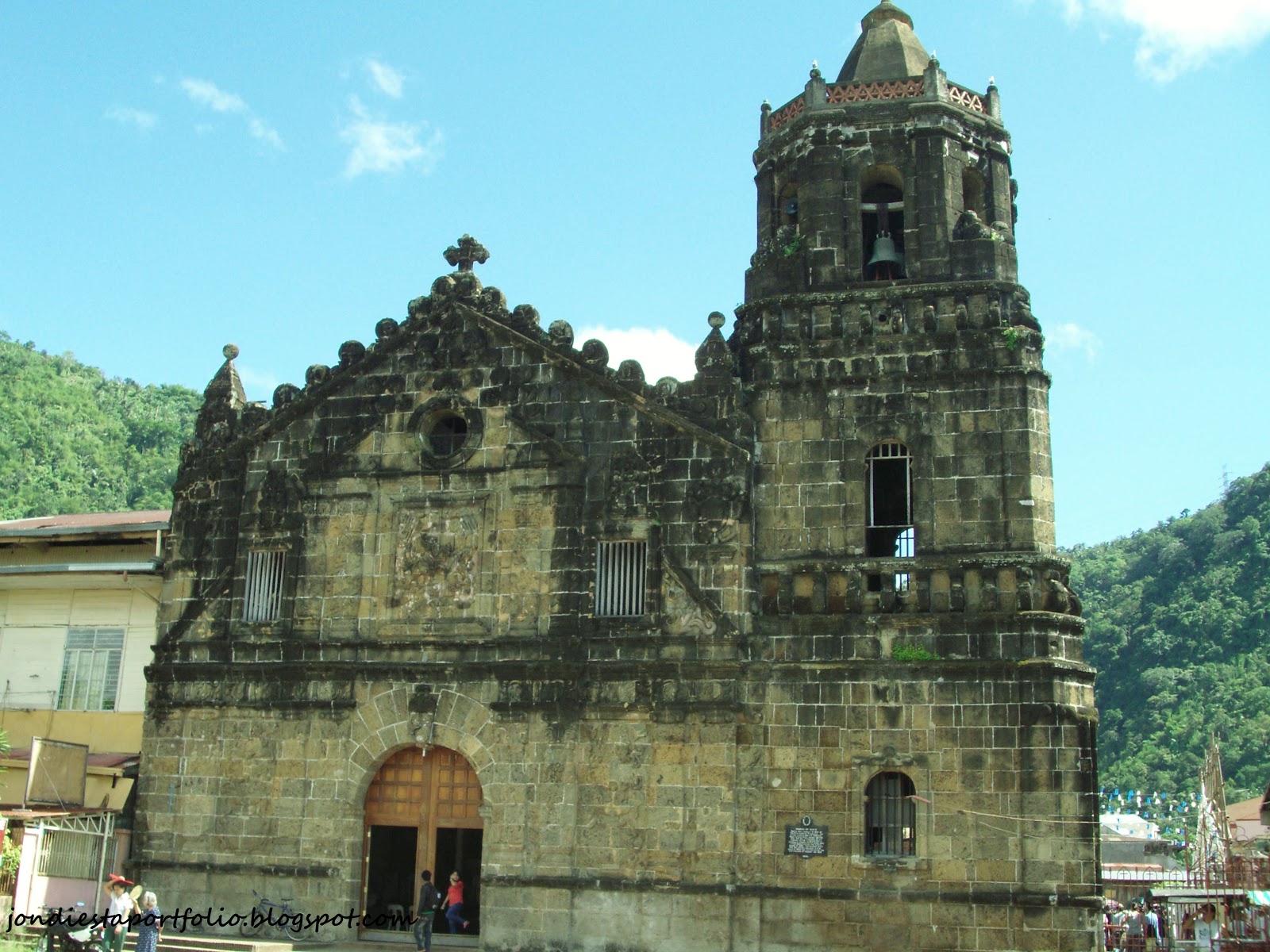
St. James the Apostle Church, Paete
Colorful paintings and murals are also popular in Paete which can be found in Islaw Art Gallery.
Today, the town is still famous for its ornamented woodcarvings and colorful papier maches, murals and paintings. There are many tourists who visited this town because they want to buy woodcarvings and witness the commemoration of Holy Week in this town. Paete is also known for its Spanish era Baroque church called St. James the Apostle Church.

Therefore, my experience in Paete is such a worthwhile visit because I appreciate the gifted talent in sculpture and painting of the natives as well with the fact that this is the town where you can appreciate the Filipino art and the observance of religious tradition during Holy Week in our country.

Activities: You can buy woodcarvings, paintings and papier maches in stores within the town proper. In addition, you can witness the Holy Week in this town and visit the Three Crosses in the top of Sierra Madre mountains.

How to Get There: From Santa Cruz, Laguna, you can ride a jeepney or drive through National Highway passing the towns of Pagsanjan, Lumban and Kalayaan. Then, turn right to J.P. Rizal Street in order to make it to the town proper of Paete.

Date of Travel: November 5, 2011 and December 18, 2011

Saturday, October 13, 2012

Shopping Galore Challenge in Liliw

I've been to Liliw four times and I always noticed the Pinoy market place scene in the town proper. I always noticed the line up of stalls and stores and even a few fast food chains. That is why, I came back here to challenge myself to have a shopping galore in this town.
The busy town center of Liliw where you can find a lot of stalls, stores and fast food chains.
The challenge here is I have only 800 pesos as my pocket money. Due to transportation fare from Cavite to Liliw, I already used 200 pesos. Now I only have 600 pesos so I decided to use 400 pesos for shopping spree in Liliw's town center.
St. John the Baptist Church in Liliw. This church was built in 1605.

The belfry of the church.
The interior of the church.
Before I started the challenge, I went to St. John the Baptist Church. I really appreciated the Baroque architecture as well with the bricked facade and the solemn ambiance of the church.
One of the markers of Cafe Arabela.
The entrance to Cafe Arabela.
The low ceiling restaurant was patronized by the locals and foreigners because of the delicious food.

Delicious lunch: Beef lasagna with toasted ginger bread plus Mango Juice.
Beef Lasagna with Ginger bread. Looks like small but makes my stomach full.
Two pieces of Brownies. 
1. Foodie Challenge:  I went to Cafe Arabela, one of the famous yet fancy restaurants in Liliw. It offers delicious food ranging from pizzas, pastas, cakes, pastries, tacos, salads, and steaks as well with its thirst-quenching beverages especially fruit juices, sodas and shakes. The restaurant also offers delicacies with a local twist especially the pasta with kesong puti (a local cheese made from carabao's milk), tanigue steak (a fish steak), and green mango shake (although it tastes so sour but I think it is delicious). I ordered Beef Lasagna, Mango Juice and two pieces of Brownies. In addition, the low ceiling restaurant was clean and patronized by the locals and foreigners who want to taste Italian food in Liliw. After I finished eating in Cafe Arabela, I decided to visit again this cozy restaurant and eat their other delicacies when I come back to Liliw
Rambutan (Nephelium lappaceum)
Lanzones (Lansium domesticum)
Durian. This fruit was originally came from Mindanao but now it is planted in the rich soils of Laguna.
2. Shopping for Fruits and Snacks: I also bought local fruits especially rambutan and lanzones because it is the harvest season for these fruits and sold in the markets of Liliw. In addition, I also bought uraro (arrowroot cookies) and the taste was really sumptuous at its affordable price. I also appreciated the fact that Liliw as well with other neighboring towns in the Banahaw region of Laguna Loop was able to plant and harvest durian which was common in Mindanao.
Colorful and sturdy yet cheap slippers and sandals are truly made from Liliw.
You can buy a product by its quality. Truly Pinoy!
3. "Tsinelas o Bayong." We all know that the town is popular for very good quality of slippers and footwear. The amount of slippers and footwear in the stalls of Liliw ranging from 50 to 200 pesos. Before, I bought an alfombra slippers worth 200 pesos. This time I bought a rubber slippers made from Liliw worth 70 pesos. I enjoyed a lot by taking a glance in seeing the line-up of slippers in every stall that I visit. Because I bought a lot of products in the town, I decided to buy a "bayong" (a bag made of indigenous material which can be used in buying products as substitute for basket) in order to carry the products easy. In addition, I am thankful to Ate who sold this bayong for giving me the discount. I really appreciate the best quality of slippers and sandals in Liliw because it is sturdy and creatively designed as well with the fact that it is affordable.

Therefore, the shopping experience completed my travel experience in Liliw. I came home to Cavite with lots of pasalubong from Laguna as well with the fact that we need to patronize our own products. Buy Pinoy!

Other Pictures:
The statue of Gat Tayaw.
Gat Tayaw Park, Liliw
Tsinelas (Sandals) is a truly Pinoy product and it can be found in Liliw.
Overall, here's the summary of all the expenses of the shopping challenge in Liliw:
  • Cafe Arabela
    • Beef Lasagna                    -   P 95.00
    • Mango Juice                     -   P 50.00
    • Brownies (2 pieces)          -   P 30.00
    • TOTAL:                              P 175.00
  • Palengke Shopping
    • Bayong                               - P 75.00
    • Rambutan (1 kilo)               - P 25.00
    • Lanzones (1/2 kilo)             - P 35.00
    • Uraro (arrowroot cookies)  - P 35.00
    • Slippers                              - P 70.00
    • TOTAL:                             P 240.00
  • GRAND TOTAL:                       P 415.00
That's it, next time if I come back to Laguna, I will visit Liliw once again to explore more interesting facts about the town as well with the great Pinoy shopping experience.

Date of Travel:  September 30, 2012

Friday, October 5, 2012

Walking Tour in the Tsinelas Town of Laguna

The statue of Gat Tayaw as a welcome mark to Liliw.
Liliw is a little known town in Laguna located in the foothills of Mount Banahaw. This verdant small town was featured in local TV commercial of a detergent bar where women are washing clothes in the river banks. The town is also the home of vast forest lands inhabited by different species of plants and animals. Today, some of its forest land converted into residential areas. Therefore, Liliw is one of the ecotourist spots in southern Luzon because of its beautiful sceneries such as the lush meadows, verdant and tall mountains and the crystal-clear waters flowing from Banahaw.

Based on a legend, Liliw was named after Gat Tayaw, the datu of the town heard a sound of the bird in a bamboo pole, saying "liw, liw, liw." During the American colonization period, the name of the town was Lilio in order to have a proper pronunciation. The town was officially called "Liliw" in 1965.

The town is known as "Tsinelas Capital of Laguna" (Footwear Capital of Laguna) where it rivals of the shoe industry of Marikina City. There are lots of slippers, sandals, alpombra and shoes which are colorful and in good quality. These footwear are made of raw materials and designed with colorful and creative decorations. Aside from the fact that it is a home of footwear, the town is also popular for its local delicacies and sweets such as uraro (arrowroot cookies), polvoron, espasol, otap and lambanog (local wine made of coconut).
A large wooden sandal which can be seen from above.
Natives from Liliw are proven to be creative because they can create huge sandals in their stall
which earned the town's title "Tsinelas Capital of the Philippines."
If you go around the town proper, you can enjoy the Filipino market scene because there are lots of local products sold from slippers, local delicacies up to fruits. You can also see the huge slippers in each stall and in Gat Tayaw Park. Just a walk away from the park, you can visit the St. John the Baptist Church. This Baroque church was built in 1605 and one of the Spanish era churches in the Laguna Loop. It is made up of bricks and one of the churches to visit during Visita Iglesia in Laguna. You can also enjoy excursion in Liliw through its clear rivers, lush forests and clean ambiance of the town.

The sturdy and colorful slippers and sandals of Liliw. (Matibay pa ang mga tsinelas na yan!)
Lots of delicacies for a sweet tooth.
Saint John the Baptist Church in Liliw, Laguna.
From Liliw leading to the next town...
How to get to Liliw, Laguna:
  • You can take a jeepney from Sta. Cruz, Laguna to Liliw, passing the towns of Pagsanjan and Magdalena which lead you to the town proper. Also, you can ride a jeepney from San Pablo City to Liliw, passing the towns of Rizal and Nagcarlan.
You can also read my December 2011 post: Navigating Laguna Loop - Liliw

Date of Travel: October 30, 2011  and November 6, 2011
© No copyright infringement intended.