Friday, May 18, 2018

Heritage Nostalgia at the Museum of the Filipino People

American actor, Brad Pitt once said "It's a lovely experience walking around a museum by yourself." I always have the habit of traveling alone, especially visiting historical sites and museums. It is my childhood dream to visit museums especially during educational tours when I was still schooling. It was a very rare opportunity to visit these places especially if I have to allot a schedule despite of hectic working days.  
The Museum of the Filipino People which was the former building of Department of Finance. 
During the celebration of Heritage Month last May 2017, I was able to visit the National Art Gallery to see the popular art works of Filipino artists from different historical periods in our country. This time, I decided to visit The Museum of the Filipino People. It is located in Agrifina Circle, next to the main National Museum, which is the National Art Gallery and the building was the former headquarters of Department of Finance.
An Ayangan house from the ancient town of Henengan, now known as Mayaoyao.
Since there is a free admission in the National Museum, I had the opportunity to visit and explore the museum. When I entered the museum, I visited the model of Ifugao house known as Ayangan. It was taken from the town of Mayaoyao, Ifugao. The abodes of the Ifugao are reflected based on their regional geography and sub-groups. The heavily thatched roof serves as protection against the rain and the cold weather of the region.
Religious images made of ivory.
Elephant tusks were used as an ivory 
Ivories were taken from sperm whale and wild pigs.


After that, I entered at the Garing: The Philippines at the Crossroads of Ivory Trade. Garing is a Tagalog word for ivory. This gallery contains different collections of tusks from elephants, whales and boars which considered as good source of ivory. In fact, the Philippines is one of the centers of ivory trade in the past and recently, the trade was prohibited in order to preserve the elephants.
The model of the San Diego.
An astrolabe used during the 16th century.


Cannons and cannon balls were used in maritime battles during the Age of Exploration.
An anchor.


The portrait of Spanish chronicler Antonio de Morga and his famous works about the Philippines.
Astronomical ring dial recovered from the San Diego Galleon Wreck.
After that, I went to the other galleries in the second level - The San Diego Exhibit and the 500 Years of Maritime Trade Before the Arrival of Western Colonizers. It is amazing to see the different artifacts such as collection of jars, clay pots, porcelains, cannons, sunken ship models and navigational devices. The galleries at the second level put me back in time during the pre-colonial times where ancient Filipinos are doing the barter with Asian traders and the adventurous maritime expeditions of the European colonizers in order to achieve their power to become an empire. I also imagined the several days of sea travel to explore new lands as well with the chronicler's journals written in black ink, ancient maps, compass and astrolabe used in navigation before the existence of travel blogs, GPS and Google maps.
Different clay jars from the Philippines and other Asian countries. 

Chinese porcelain plates.

Chinese porcelain kitchen set
Porcelain kitchenware from the ruins of a shipwreck.

Old clay jars and metal instruments from the remains of the shipwreck.
On the third level of the museum, I also had the chance to discover the indigenous Filipino culture through Kaban ng Lahi: Archaeological Treasures and Lumad Mindanao. I've had the chance to see the Manunggul Jar, a burial jar used by the ancient Filipinos which was excavated in Palawan during the 1960's.
The Manunggal Jar


I also visited the section called Lumad Mindanao. It features the different artifacts and materials such as indigenous musical instruments, colorful tribal costumes and household materials from the tribes living in Mindanao. There are also sections for Rice Farming in the Philippines, History of Writing and Weaving in the Philippines.

Therefore, I've had a chance to come back again in this museum and to explore more of the Philippine culture. Discovering the anthropological and archaeological roots of our country is very interesting in order to explore the traces of our Asian identity as a Filipino.

*This post is intended for the National Heritage Month to promote museums and discover our cultural heritage.

Date of Travel: December 17, 2016

Saturday, May 5, 2018

The Other Side of the Scenic Panorama: La Virginia Resort

Some tourists witnessed the scenic panorama of Taal Lake and Taal Volcano from the highlands of Alfonso and Tagaytay City in Cavite as well in the towns of Talisay and Laurel in Batangas. In fact,  there are tourists who visited the other side of the panorama where they can see the bird's eye view of Tagaytay City

Recently, I had a chance to visit the small town of Mataas Na Kahoy in Batangas due to team building activity. The small town is located next to Lipa City and Balete. The town is known for its cool climate due to its high elevation of 379 meters. There are many resorts in the town and La Virginia is one of the popular tourist destinations found in this place.
The dolphin pool teemed with the lush green mountains in the background together with the view of Taal Lake.
The infinity pool where you can enjoy the view of Taal Lake.

The view of Taal Lake and Taal Volcano from Mataas na Kahoy, Batangas.
This highland resort is an ideal place for team building activities. In fact, there are many games to be done in this place because of its hilly terrain and plenty of swimming pools and life-sized images ranging from fairy tales, cartoon and Biblical characters. For example, our school enjoyed the Amazing Race for our yearly team building activity and it is amazing to share that I would like to come back in this place. 

Date of Travel: April 11, 2017

Thursday, April 13, 2017

Visita Iglesia: Pilgrimage at the Highlands

I always have my Visita Iglesia or Pilgrimage in my home town, Cavite. This year, I decided to explore the churches in the highlands. In fact. I went to seven churches located in the upland towns of Cavite namely Alfonso, Mendez and Tagaytay City. 
The belfry of the church.
The facade of San Juan Nepomuceno Parish Church located in Alfonso, Cavite
San Juan Nepomuceno Parish Church
Alfonso

The first church that I visited this year was the San Juan Nepomuceno Parish Church located in the poblacion or town center of the highland town, Alfonso. It became a town in 1859 and the church was established in 1861 where Rev. Fr. Jose Sta. Maria was the first parish priest of the town. It is one of the oldest churches in Cavite which is depicted in its architecture. 

The facade of Saint Augustine Parish Church in Mendez.
Saint Augustine Parish Church
Mendez

The next church that I visited is the Saint Augustine Parish Church. It is located in the center of the small yet peaceful town of Mendez, Cavite. Its notable feature is the twin bell towers and the only one in Cavite.  It was established in 1881 and it celebrated its 300th anniversary last 2015. 
The facade of Our Lady of Lourdes Parish in Tagaytay City.
Our Lady of Lourdes Parish Church
Tagaytay City 

It is known as the healing church, it was established in 1940 by the Order of Friars Capuchin. The place is very ideal for weddings because of its beautiful landscape and cool climate. The parish is located in the heart of Tagaytay City along the Tagaytay-Nasugbu Highway.
The facade of Tierra de Maria with the image of Our Lady of Manaoag. 
Our Lady of Manaoag at Tierra de Maria 
Tagaytay City 

The Tierra de Maria was established twenty years ago by the late Bro. Jiggers G. Alejandrino. The church now is run by his widow and their children and it is also a place of healing and worship for Catholic devotees of the Our Lady of Manaoag. 
Ina ng Laging Saklolo Parish Church
Tagaytay City

A few minutes away from Tierra de Maria, the Ina ng Laging Saklolo which is located along Tagaytay-Calamba Highway. The church is also operated with Order of Capuchin Friars, the same with Our Lady of Lourdes Parish. 
Angels Hills Retreat and Formation Center
Angel's Hills Retreat and Formation Center
Tagaytay City

It is one of the prayer houses located in Arnoldus Road and this is the sixth church that I visited. It is located near various religious centers including the Pink Sisters Chapel. 
The Pink Sisters Adoration Convent of Divine Mercy
Tagaytay City 

A few minutes walk from the Angels Hills, I went to the Pink Sisters Convent located in Tagaytay City. It is a very popular convent which was visited by tourists and religious devotees, the place is known for nuns who are wearing pink uniforms and a relaxing place filled with trees and plants. 

I also want to visit the Saint Mary Magdalene Church in Amadeo, Cavite but it was already late due to the approaching evening. Therefore, it is always a pleasure and religious practice to do the Pilgrimage to the Seven Churches even in our hometown in order to profess our faith and reflect to all the things that we have done that God saved us from challenges and the fact that we are blessed with opportunities in life. 


Date of Travel: April 12, 2017

Saturday, April 1, 2017

Travel Throwback: A Visit to the Iconic Churches of Metro Manila

Metro Manila is known as the place where there are plenty of traffic jams, busy metropolitan scenario, hectic schedule of the people and the urban atmosphere. Despite of the city ambiance in the Metro, there are preserved religious treasures that played an important role in the history of the region and the fact that National Capital Region (NCR) is an ideal place for Visita Iglesia. The urban area is populous yet accessible to transportation modes.
The San Sepulcro Parish Church in Laguna was visited by many devotees during Holy Week.
The first church that I visited which is located outside the south of Metro Manila is the San Sepulcro Parish Church in San Pedro City, Laguna. The church is near in my home town. In addition, the church is popular among religious devotees especially during the Holy Week where the miraculous Jesus in Holy Sepulchre, also known as Lolo Uweng can be found here. It is a pilgrim's place for healing since some devotees believed that Lolo Uweng may grant your wishes and heal your illnesses through praying.
Saint Peregrine Laziosi Church
I also visited the Saint Peregrine Laziosi Church in Tunasan, Muntinlupa City. Saint Peregrine is the patron saint of the cancer patients. It became a parish on 1985 and it is under the pastoral care of the Order of Servants of Mary. In addition, there are many testimonies of healing happened in this church.

Saint Joseph Parish Church, the home of Las Pinas Bamboo Organ
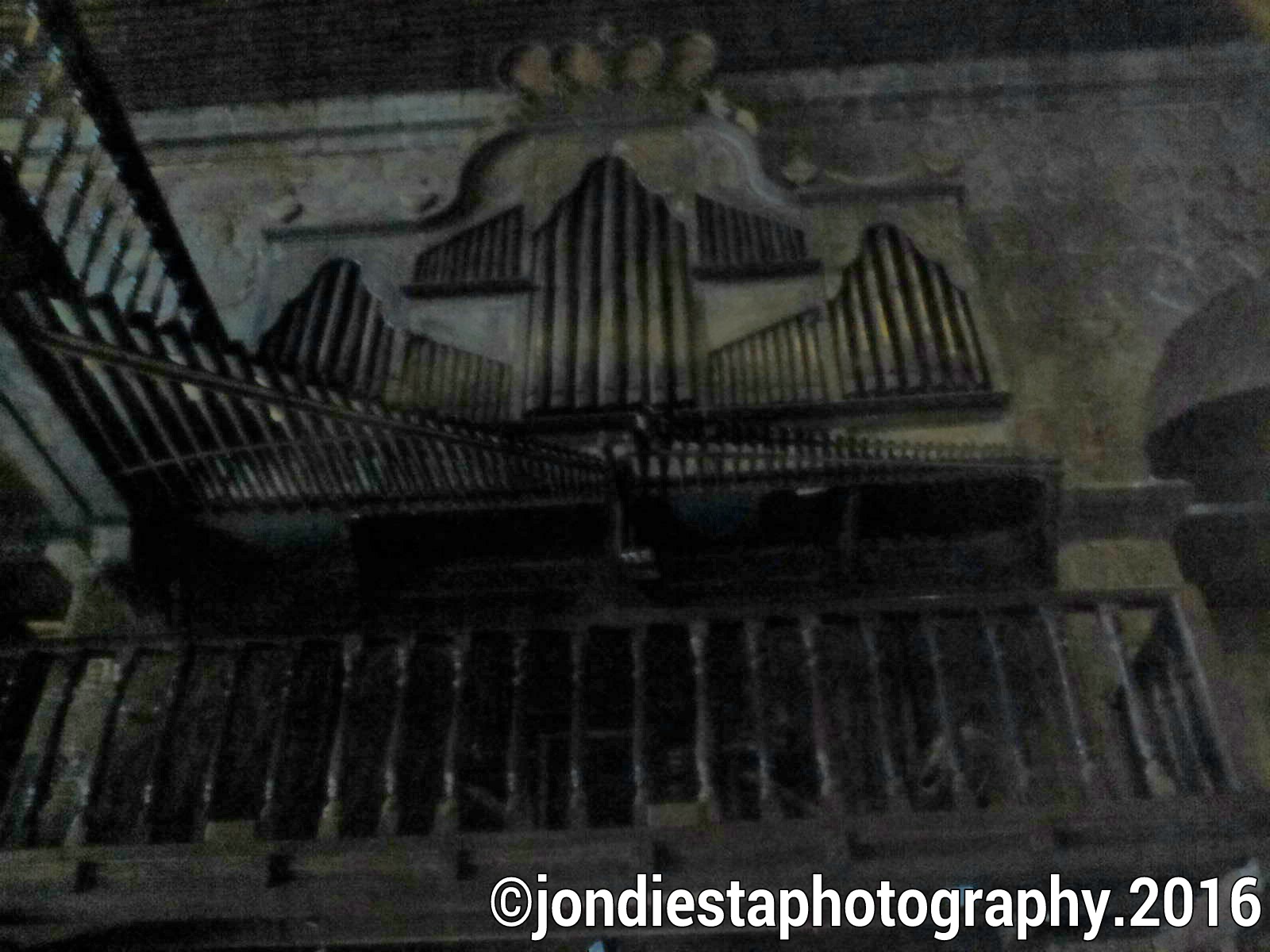
From Muntinlupa, I went to Las Pinas City to visit one of the historical churches, the Saint Joseph Parish Church. It houses the cultural treasure, the Las Pinas Bamboo Organ a pipe organ made mostly with bamboo pipes. It was completed by Father Diego Cera in 1824, the builder of the town's stone church and the first resident Catholic parish priest. It was shipped to Germany in 1972 for restoration because it was unplayable for a long period of time due to ages and numerous disasters. The organ was returned in 1975 and it became a National Cultural Treasure in 2003.

The Las Pinas Bamboo Organ, a National Cultural Treasure.
The Saint Andrew Cathedral in Paranaque City is the next stop for this pilgrimage. Built in 1590, it is one of the oldest churches in the Philippines. The church is the seat of Roman Catholic Diocese of Paranaque that comprises the cities of Paranaque, Las Pinas and Muntinlupa.
Saint Andrew Cathedral
A few minutes away from the town proper, the National Shrine of Our Mother or Perpetual Help also known as the Redemptorist Church located in Baclaran. It is a prominent Catholic national shrine located in Roxas Boulevard, it enshrines the icon of Our Mother of Perpetual Help. It is also historical where the late Pope John Paul II visited the church on 1981. Prior to that, he first celebrated the Holy Eucharist here as the Cardinal - Archbishop of Krakow as Karol Jozef Wojtyla on 1973.
Baclaran Church
I visited again the Malate Church, Santa Cruz Church and Binondo Church after two years which was my first Visita Iglesia in Manila. There are renovations made in the church especially in Malate and Binondo as part of the restoration program of the heritage sites in Manila. In addition, I also walked from Santa Cruz Church passing the Chinatown in order to make it in Binondo Church.
Malate Church

The facade of Santa Cruz Church 
The Binondo Church with its renovated facade.

Lastly, I also visited the San Sebastian Church in Quiapo. Recently, the church has encountered threats to structural integrity where there are rust and corrosion in its steel structure due to sea breeze near the Manila Bay. In fact, the San Sebastian Basilica Conservation and Development Foundation Inc. holds day tours in the church. During the visit, there are tour guides who tell us the story of the church and the advocacy of preserving the National Cultural Treasure.
The Basilica Minore de San Sebastian is the only steel church in the Philippines.
The tour guide is telling the advocacy of preserving the San Sebastian Church.

The interior of the steel church.
Despite of the urban life in the Metro, these religious structures are still treasured by the local government and the Catholic church. They went to restoration programs by doing major renovations in their structure because they want to preserve these cultural treasures in order to save our heritage not just from natural disasters but also to continue the Filipino cultural legacy in our society up to the future. 

You may also read this article Visita Iglesia: Heritage Churches in Manila 

Date: March 24, 2016

Saturday, July 16, 2016

Manila Heritage Nostalgia | A Free Tour in the National Art Gallery

As I walked in the scorching heat of the metro along with the heavy traffic on the streets, I decided to visit the National Museum of Fine Arts or the National Art Gallery where I need to celebrate the Heritage Month. In addition, the said institution has a promo where there was a free admission for the whole month of May.

The current museum was the Old Legislative Building (Old Congress Building) which is located in Padre Burgos Avenue, Ermita, Manila located near the Manila City Hall. The building was planned based on the design of Ralph Harrington Doane and Antonio Toledo for the National Library in 1918 but it was changed into a legislative building based on the plan of Juan Arellano in 1926. Some of the historical events happened in this building such as the Constitutional Convention led by Claro M. Recto in 1934 and the presidential inaugurations of Manuel L. Quezon in 1935, Jose P. Laurel in 1943 and Manuel A. Roxas in 1946. It was destroyed during the Second World War and it was restored which was turned into Congress Building in 1949. During the declaration of Martial Law in 1972, it was the office of the Prime Minister and it returned back into Congress Building in 1987. On February 12, 1998, the building was declared as the National Museum and it became a National Historical Landmark on September 30, 2010.

The National Museum was divided into three buildings - the National Art Gallery or the National Museum of Fine Arts which was located in the Old Legislative Building, National Museum of Anthropology or the Museum of the Filipino People which was the old building of Department of Finance and the National Museum of Natural History which was occupied by the Department of Tourism.  
The facade of National Art Gallery of the National Museum.
When I entered the institution and left my stuff in the baggage counter, I brought my tablet to take notes for important details to study the art and history of our country. First, I visited the Old House of Representatives Session Hall where the famous artworks such as "Spoliarium" by Juan Luna and "The Assassination of Governor Bustamante" by Felix Resurreccion Hidalgo are found in this area. In fact, I also had the chance to see another popular work of Juan Luna "The Parisian Life" in the GSIS Hall.
"Spolarium" by Juan Luna
"The Assassination of Governor Bustamante" by Felix Resurreccion Hidalgo
"The Parisian Life" by Juan Luna in the GSIS Hall.
After visiting the Spoliarium Hall, I went to Ablaza Hall whersome Christian themed masterpieces from 17th to 19th century. There are different wooden retablos and religious relics found in this hall. Then, I also had a chance to have a glance of our rich flora in FCCP Hall where the paintings by Juan Perez de Cuellar which focused on the Philippine plants are located. 
The FCCP Hall which features the botanical art works which are done by Juan De Cuellar. These drawings are featured in the Royal Botanical Garden n Madrid, Spain.
A retablo.
There is also a gallery dedicated for Dr. Jose Rizal which showcases the different portraits of our national hero which was done by different artists and his sculptural works such as "El Ermitano" and "Mother's Revenge."
The portrait of Dr. Jose Rizal
A portrait of Dr. Jose Rizal, Ermitanyo (upper right) and Mother's Revenge (lower right). The two sculptural art works are examples of terra cotta.
In MFP Hall (Gallery X) you can find the series of paintings which was done by Carlos "Botong" Francisco entitled "The Progress of Medicine in the Philippines." These masterpieces were found in the Philippine General Hospital and today, it has a new home in the National Art Gallery. 
"The Progress of Medicine in the Philippines" by Carlos "Botong" Francisco. 
I also had a chance to visit Silvina and Juan C. Laya Hall where some artworks which was made during the World War II was displayed in that gallery.
Some of the art works that depict the life and historical events during World War II.. 
oAnother set of artworks that feature the life during the World War II.
You may also visit the galleries which feature the works of Fernando Amorsolo, Guillermo Tolentino, Vicente Manansala, Jose T. Joya, Hernando Ocampo and Carlos "Botong" Francisco as well with the masterpieces of contemporary artists such as Benedicto "BenCab" Cabrera, Arturo Luz and Mauro "Malang" Santos/ In addition, there are also masterpieces from local artists which feature the historical events and tackled on  political and social status of our society from 1960's to the early 1990's. 
The masterpieces of Guillermo Tolentino featuring the arch of the Commonwealth of the Philippines.. The works of Guillermo Tolentino can be found in  Gallery XII or Security Bank Hall.
Artworks of  Hernando Ocampo
"Fishes" by Vicente Manansala
"Pagkain" (Food) by Vicente Manansala. These paintings by Vicente Manansala featured transparent cubism.
"Plantng of the First Cross' by Vicente Manansala
Artworks with the theme of restoration of democracy during the EDSA Revolution..
The art works of Benedicto Cabrera, also known as BenCab .
Portraits of prominent politicians, celebrities and business figures in a hallway.
As you walked inside the historical building, passing the dim aisle teemed with the cool air, you can see various artworks that reflect in the history and culture of our country. You can travel back in time as you see the different masterpieces that showcase the life during the pre-colonial period, seeing the Romantic paintings during the Spanish era that depict religious and patriotic themes, the historical struggles which are reflected in the paintings during the World War II, Martial Law Era up to the EDSA Revolution and the creativity of artists in the modern and contemporary period which proved that visual art, painting and sculpture has a place in the world full of technology and digital information.

Therefore, it is highly recommended that you need to visit museums in order to take a glance of our history through art and the appreciation of the works of our national artists who shared their God-given talent in order to enhance the richness of culture and talent in our art. 

The National Museum is open from Tuesday to Sunday from 10:00 a.m. to 5:00 p.m. Admission is permanently free of charge effective July 1, 2016. The National Art Gallery can be found in Padre Burgos Drive, Rizal Park, City of Manila. 

Website: http://www.nationalmuseum.gov.ph/

Date of Travel: May 25, 2016 and December 17, 2016
© No copyright infringement intended.